
Dickinson County Release Date Types
“Release date” can name several different fields. Dickinson County's Tyler detail schema includes both Release Date and Scheduled Release Date. Kansas corrections uses the more precise term anticipated guidelines release date for many state prisoners. KASPER can also show parole eligibility, conditional release, sentence expiration, movements, and supervision status. These labels answer different questions.
A scheduled or anticipated date is a plan based on the information and legal rules then in effect. An actual Release Date should mark the administrative end of a booking when populated. A court order may authorize release before jail staff finish book-out. A facility movement can show transfer while the person remains confined. Keep the source and label attached to every date.
| Date or status | Meaning | What it does not prove |
|---|---|---|
| Scheduled Release Date | A prospective county booking field | That book-out occurred or no hold exists |
| Actual Release Date | The recorded end of that booking | Community freedom if the destination was another custodian |
| Anticipated guidelines release date | KDOC's computed end of the prison portion | Final discharge from state authority |
| Parole eligibility | Earliest board consideration for an eligible sentence | A grant or physical release |
| Sentence expiration or discharge | Outside end or completed KDOC authority, as labeled | Erasure of the court case |
Important: A scheduled date is not an actual release. Confirm the event and destination after the date arrives.
Find Dickinson County Release Dates
Choose the record by custody lane. A person awaiting trial at Dickinson County Detention Facility does not have a sentence-based date to calculate. A person serving a local sentence needs the court judgment and jail computation. A person committed to KDOC needs the state offender and sentence record.
- Identify whether the person is pretrial, serving a county sentence, committed to KDOC, or in federal or immigration custody.
- For a county booking, search the official Tyler roster and read Scheduled Release Date only if it is populated.
- Call the Dickinson County jail at 785-263-4734 for current book-out confirmation. Request the booking/release sheet when the precise date and destination matter.
- Review the Kansas Judicial Branch Case Search for the sentence, bond order, commitment, revocation, or later correction.
- For a state prisoner, search KASPER and keep each sentence and release field under its official label.
- Near the date, confirm with the custodian. Use a custody alert as a supplement, not as the computation record.
The official Tyler roster view below shows the county search source and its current-custody focus. Detail records can contain release fields, but public testing did not reveal a released-person archive.
View the Dickinson County roster source before using the screen controls.
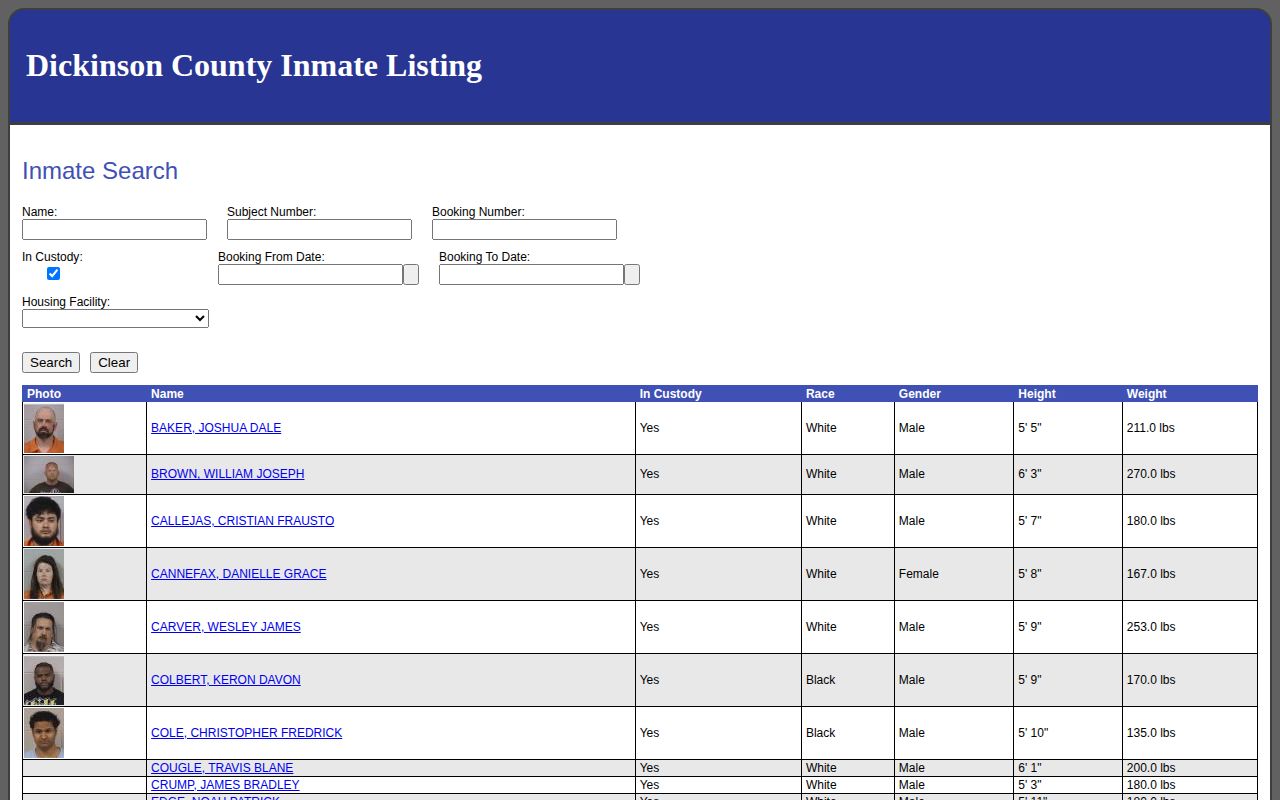
The roster can support identity and a current booking, while the jail record remains the source for a completed county book-out.
KASPER Dickinson County Release Fields
KASPER searches by first, middle, and last name; aliases; KDOC registration number; KBI state identification number; birth date or age; race; gender; conviction county; supervision county; community-corrections location; facility; and supervision type. The KDOC number is the best unique state key. A county booking number is a different identifier.
The public state inventory includes sentence-begins date, sentence structure, anticipated guidelines release date, parole eligibility, conditional release, sentence expiration, current location, facility movements, supervision type, and the parole office that maintains supervision. Sentence-begins date can reflect qualifying presentence jail credit under K.S.A. 21-6615. It should not be replaced with prison arrival date.
KASPER's official search and disclaimer provide the live state record source.
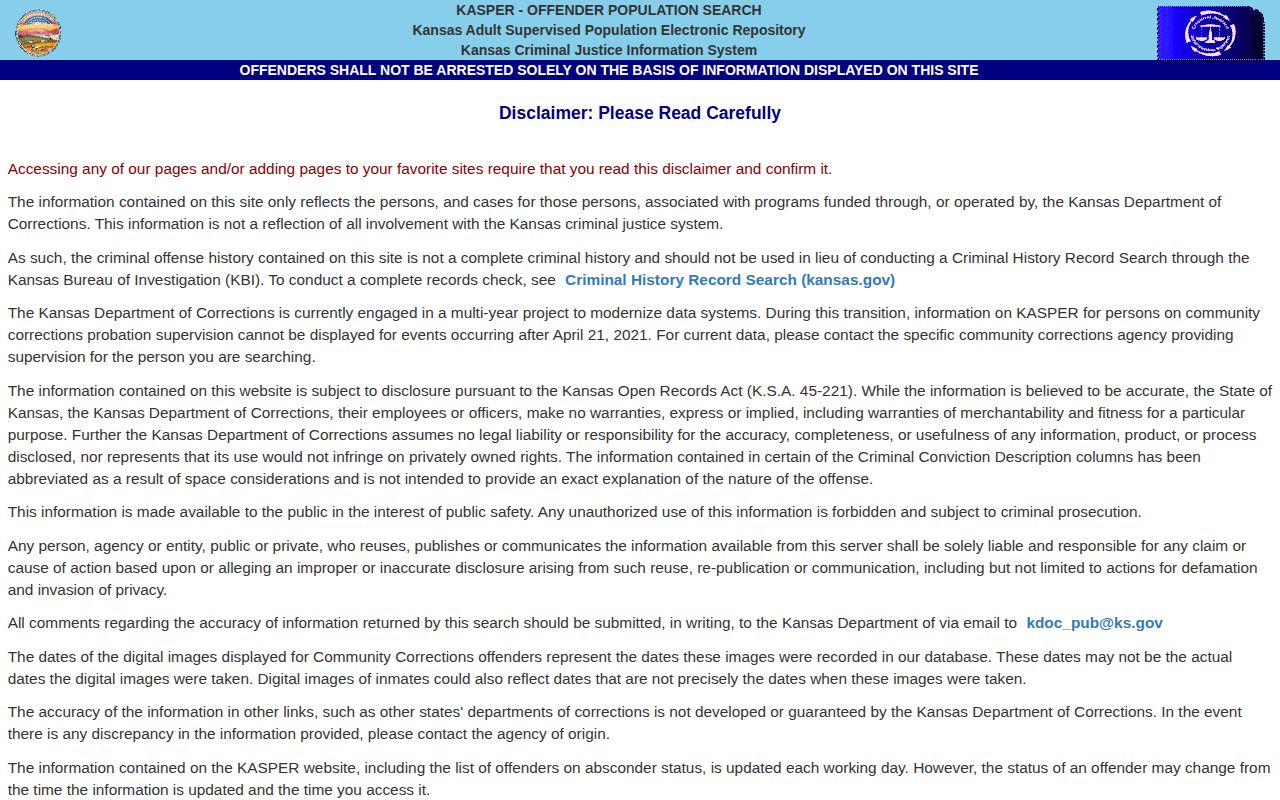
The KASPER record must be read field by field. A move between prisons is continued custody, while parole or postrelease status points to community supervision.
Note: KASPER states that it updates each working day, so confirm close to the expected event.
Kansas Release Date Computation
Kansas K.A.R. Article 6 calculates the anticipated guidelines release date from the sentence-begins date and prison portion, then accounts for earned or awarded good time and any forfeiture. For concurrent guidelines sentences, K.A.R. 44-6-140 makes the sentence that requires the longest service control. Consecutive sentences and more than one case can create a different structure.
K.S.A. 21-6806 states that a guidelines prison sentence represents actual service subject to good-time reduction. Credits are not automatic arithmetic for the public to apply. They must be earned, can be forfeited, and operate within the offense date, severity, and sentence rules that govern the case.
Presentence jail credit also matters. The sentencing court designates a sentence-begins date reflecting qualifying credit. A court correction, later revocation, or error in the credit record can therefore change the state computation without any change to the original term stated in months.
Does Kansas Require 85 Percent?
The common claim that Kansas inmates always serve 85 percent is too broad. It is shorthand for the ordinary 15 percent good-time cap that applies to many guidelines crimes committed on or after July 1, 1993. K.S.A. 21-6821 contains the actual limits and qualifications.
Identified lower-severity nondrug and drug crimes within the statute's date and category rules may allow up to 20 percent good time. Eligible people serving only specified severity levels may also receive limited program credit. Mandatory-minimum and off-grid cases can prevent ordinary reductions. Old-law indeterminate sentences use parole eligibility concepts instead of a simple guidelines percentage.
No percentage should be applied to a Dickinson County pretrial detainee. Nor should the KDOC rule be imposed on a local jail sentence without the actual judgment and jail computation. The safe answer is the date the responsible agency publishes, paired with its precise label and a later check for the actual release.
Dickinson County Date Changes
Projected dates move when the facts behind the calculation move. Some changes affect the prison term. Others stop a planned county release because a different authority is waiting.
| Factor | Possible effect | Record to check |
|---|---|---|
| Good-time award or forfeiture | Moves the anticipated guidelines date within the applicable rules | KDOC sentence computation |
| Program credit | May reduce time for a qualifying sentence | KDOC eligibility and computation record |
| Presentence jail credit | Changes the sentence-begins point | Court judgment and KDOC sentence field |
| Consecutive or controlling sentence | Extends the time required by the full structure | Individual and controlling sentence fields |
| New court order or revocation | Changes the lawful term or returns a person to custody | Dickinson court register and filed order |
| Warrant, detainer, or other hold | Can replace community release with transfer | Jail destination and receiving-agency record |
| Parole decision | Affects eligible old-law or specified sentences | PRB process followed by later KASPER status |
A detainer is a request or legal basis for another authority to take custody. It can mean Dickinson County books the person out to KDOC, another jail, USMS, or ICE. That is not release to the community. Follow the receiving system before stating that confinement ended.
Dickinson County Parole Dates
Parole eligibility is not an anticipated guidelines release date. Traditional parole mainly concerns indeterminate old-law and specified life or off-grid sentences. Under K.S.A. 22-3717, eligibility means the Kansas Prisoner Review Board may consider release. It does not mean the board will grant it.
The PRB monthly schedule and offender list can show a hearing month and earliest possible release month. County of conviction may be Dickinson, but that does not prove planned residence in Dickinson County. No standalone public named-person decision database was found. After the hearing, use the PRB process language to understand possible outcomes and check KASPER later for actual supervision status.
A parole or postrelease label means prison confinement ended while KDOC supervision continues. Discharged indicates a later and stronger end point for KDOC authority. The Dickinson County VINELink Release Check can add an event alert, but it does not calculate either date.
Confirm Dickinson County Actual Release
On or after a scheduled county date, look for an actual Release Date, call the jail, and request the release record if exact time or destination matters. A blank release field is not an invitation to estimate. It means no displayed value was populated for that booking.
For KDOC, compare anticipated date, current location, movements, supervision type, and sentence expiration. If the person enters parole or postrelease supervision, prison release occurred but discharge did not. For formal proof, KDOC public records can provide public sentence and release information or a maximum-sentence discharge certificate.
Court and custody time stamps serve different roles. The court order supplies legal authority. The jail or prison record supplies physical movement. Processing and holds can create a gap between them. Keeping both records resolves most conflicts without turning a plan into a false claim of release.
Public Record Search
Sponsored Results