
USMS Custody Is Not Release
The U.S. Marshals Service prisoner program manages federal prisoners during court proceedings and transport. The agency may use contract detention space, so physical location and legal custodian can differ. No separate USMS detention facility was identified in Dickinson County.
If the Dickinson County Detention Facility books a person out to USMS, county custody has ended. The person has not necessarily entered the community. Federal detention continues under a new custodian. The county administrative record should establish the local exit and destination if maintained. The federal docket explains the court authority and later outcome.
“Released to USMS” means transfer from Dickinson County custody, not freedom from detention or release to the community.
Trace a USMS Transfer
No single public screen supplies the whole USMS chain. Start with the record closest to the observed event and keep each agency's identifier separate.
- Search the Dickinson current roster only to determine whether the booking still appears, not to prove release.
- Call the jail and ask whether the booking closed and whether the public record identifies a transfer destination.
- Request the booking or release ledger entry with actual book-out time, releasing authority, and destination if maintained.
- Locate the federal docket by case number or confirmed identity and review detention, transfer, judgment, and release entries.
- Use USMS information for the pretrial or transport stage.
- After federal commitment, search the BOP locator by register or other official number.
The Dickinson County released-inmate search path supplies the local request process. Roster disappearance alone remains ambiguous because transfer, spelling, and update timing can produce the same observation.
No USMS Public Locator
USMS does not provide a general public historical locator equivalent to the Federal Bureau of Prisons locator. That absence changes the workflow. A no-result in BOP cannot be treated as proof that a USMS detainee was released. The person may still be pretrial, in transit, housed under contract, or not yet entered into the BOP population.
The federal docket is the durable public source for court events. It can show detention decisions, appearances, judgment, sentence, or a release order when public. Yet an order is legal authority, not always the physical departure time. Processing, a separate hold, or transport may follow. Agency confirmation or an official custody record is needed when the precise exit matters.
Note: Search tools should follow the legal custodian, not just the building where the person may be housed.
USMS and BOP Roles
USMS and BOP are federal agencies with distinct custody roles. Combining them produces false release claims.
| System | Typical role | Public route |
|---|---|---|
| USMS | Federal pretrial custody and transport | Federal docket and agency contact; no comparable historical locator |
| BOP | Federal post-conviction imprisonment | BOP Inmate Locator |
| Dickinson County | County booking and local jail custody | County roster, jail confirmation, and release record |
| KDOC | Kansas prison custody and state supervision | KASPER and KDOC records |
| ICE | Immigration detention | ICE Online Detainee Locator for current searchable custody |
A person may pass through more than one row. The record at each boundary should show whether custody ended altogether or merely shifted.
Dickinson Release Record First
The Dickinson County roster was observed as current-custody first. It did not expose a public recent-release archive. An absent name therefore does not disclose community release or USMS transfer. The jail's booking and release record is the best source for the actual county exit.
A narrow request should identify the full name, date of birth or subject number where appropriate, booking number, and date range. Ask for the booking or release sheet showing actual release date and time, release status or destination if maintained, and releasing authority. Do not ask the county to create a new explanation. Request an electronic copy and an itemized estimate through the county clerk.
The district court and county jail share a Dickinson County address, but their functions differ. The court explains a local order. The jail timestamps the county book-out. A federal docket then explains the federal process. Those records should be aligned rather than blended.
Federal Docket Evidence
The federal case number is the best key for the legal stage. A docket can distinguish an initial appearance, detention order, bond order, plea, judgment, commitment, revocation, and other filed events. It may show why USMS custody began and whether a court later ordered release.
A court-ordered release still needs careful wording. The order may precede the actual physical exit, and another jurisdiction may hold the person. Confirm whether all holds cleared. If the person went from USMS to BOP after sentencing, the BOP locator becomes the relevant public status source. If the person returned to Dickinson County, a new county episode needs its own booking number.
- Detention order
- A court direction that custody continue while a federal case proceeds.
- Commitment
- A court direction placing a sentenced person into federal custody.
- Release order
- Legal authority for release, subject to processing and other holds.
- Custody transfer
- A change in responsible agency while detention continues.
BOP Search After Commitment
Once a person enters the BOP population, the BOP locator can search by BOP register, DCDC, FBI, or INS number, or by name and biographical fields. A former prisoner may appear as released or not in BOP custody with a release date. Compare the number and identity before using the result.
The official BOP search image shows the federal locator that follows the USMS stage when commitment occurs.
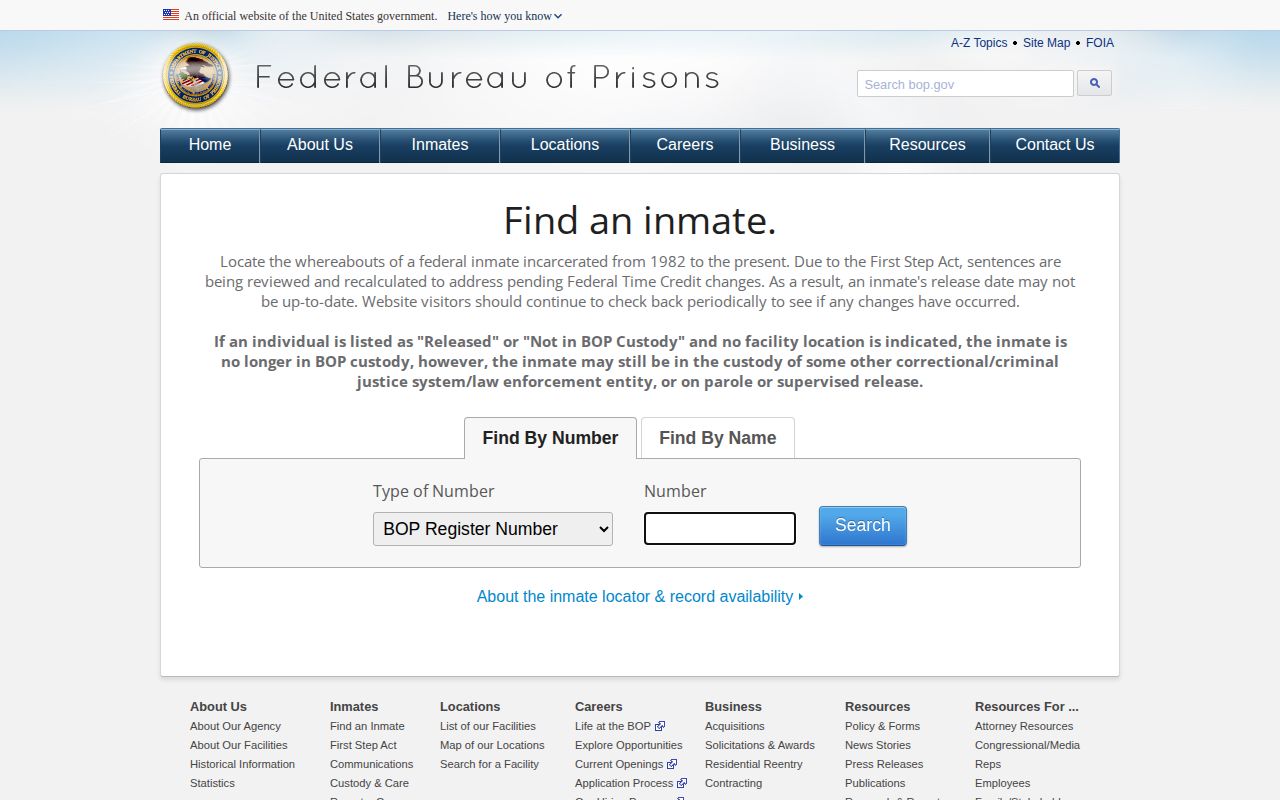
A BOP result cannot certify the earlier Dickinson book-out or every event during USMS pretrial custody.
USMS Transfer False Positives
Several observations can look like release but prove less. A name leaving the Dickinson roster says only that the current search no longer returns the booking. A federal court hearing does not by itself show that the person walked out. A BOP no-match does not show that USMS custody ended. A later BOP released result does not reveal where the person went after the federal term.
| Observation | What it does not prove |
|---|---|
| Dickinson name disappears | Community release rather than transfer |
| Federal bond order entered | Bond completion or clearance of every hold |
| No BOP result | Release from USMS custody |
| BOP shows released | No later county, state, or ICE custody |
| USMS transport reported | Final destination or case outcome |
Use affirmative records rather than filling these gaps with assumptions.
USMS and ICE Holds
Federal criminal detention and immigration detention are separate. A person leaving USMS or BOP can still enter ICE custody when the record supports that transition. ICE ODLS searches current searchable immigration detention, not historical USMS movement.
No official evidence showed that Dickinson County operates an ICE facility or has a current ICE detention contract. Federal and immigration routes are contingency paths for an individual case, not local-facility claims. If the county record names ICE as destination, use ODLS and the official information line. If it names USMS, begin with the federal docket.
USMS Release Proof Chain
The safest conclusion follows the custody chain. First establish when Dickinson County custody ended. Next identify whether the destination was USMS. Then review the federal court outcome. If commitment followed, check BOP. If a release order followed, confirm physical release and any other hold with the proper authority.
For personal legal process, preserve copies with their source and retrieval date. Record a docket entry as a court event, a county ledger entry as local book-out evidence, and a BOP result as BOP status. Avoid shortening all three to one unlabeled “release date.”
No public USMS historical locator fills the middle gap. That is a real limitation, not a reason to invent a result. Direct agency and court records remain the appropriate fallback.
USMS Timing and Record Gaps
Public systems can update at different speeds. The Dickinson roster may stop returning a booking before a federal docket shows the next movement. A federal hearing may appear before the person is physically moved. BOP may not return a result until the post-conviction population and its records are updated. None of those timing gaps proves that custody ended.
Ask narrow questions during the gap. Did the Dickinson booking close? Does the public release record name USMS or another destination? What federal case number connects to the transfer? Does the federal docket show detention, bond, judgment, or commitment? Has a BOP number been assigned? Each answer narrows the next step without asking one office to research the entire history.
A federal bond or release order should also be read with care. It can authorize release after listed terms are met, but it does not by itself prove completion, exact exit time, or absence of another hold. The same principle applies to a local court order. Legal authority and physical book-out are related events, not interchangeable records.
When the evidence stops at a USMS transfer, state exactly that. “Dickinson County custody ended in a transfer to USMS” is supported if the county record says so. “Released to the community” requires affirmative federal release evidence and clearance of other custody. Honest limits are more useful than a confident guess.