
KDOC Releases from Prison
Kansas Department of Corrections facilities form a statewide prison system. None was identified as physically located in Dickinson County. A Dickinson County court may commit a sentenced person to KDOC, and the county jail may then record a transfer. That county book-out ends the Dickinson booking only. It does not show community release.
A later KDOC record can show prison confinement, movement to another Kansas institution, parole, mandatory postrelease supervision, another community status, or discharge. Parole or postrelease means prison custody ended while state authority continues. Discharged is stronger evidence that KDOC authority ended. The exact label and record date matter. A facility movement alone shows continued state custody.
A Dickinson County transfer to KDOC is continued custody, not a community release, even when the person vanishes from the county roster.
Confirm a KDOC Release
The official KASPER offender search is the first public route. Search by a unique number when possible. A name match should be checked against birth information, physical description, conviction county, and case details before any status is attributed to a person.
- Open KASPER, read its disclaimer, and choose the offender search.
- Enter the KDOC registration number or KBI state identification number when known. Otherwise use the full name and available identity fields.
- Open the matching record and read supervision type, current location, release fields, sentence structure, and movement history together.
- Distinguish a prison move from parole, postrelease, or discharge. Record the field label and its date.
- If formal proof is needed, request the public release or discharge record from KDOC rather than relying on a screenshot.
The Dickinson County search and release-record path helps reconcile a county booking with the later state episode. A county booking number and a KDOC number are different identifiers, so keep both.
KDOC Search Fields
KASPER carries more than a single “release date.” The fields answer different legal and custody questions and should not be merged.
| Field | What it shows |
|---|---|
| KDOC registration number | The best unique key for the state corrections record. |
| Supervision type | Inmate, parole, community status, absconder, or discharged status as reported. |
| Current location | A prison or community supervision location, depending on status. |
| Anticipated guidelines release date | A calculated end of the prison portion, not proof of actual release. |
| Parole eligibility | When an eligible old-law or specified sentence may be considered, not a grant. |
| Conditional release | A separate statutory concept for applicable indeterminate sentences. |
| Sentence expiration | The outside sentence or maximum-discharge point reported by KDOC. |
| Facility movement history | Transfers within state custody and their dates. |
A sentence-begins date incorporates the court's designated computation point and qualifying jail credit. It is not the date the person reached a prison. Individual sentence structure and the controlling sentence also differ when cases run at the same time or back to back.
KDOC Dates Need Labels
Kansas uses the precise term “anticipated guidelines release date.” The date is prospective. Earned or forfeited good time, sentence structure, jail credit, a court correction, consecutive cases, revocation, or a hold may change it. K.S.A. 21-6821 generally caps good time at 15 percent for covered crimes committed on or after July 1, 1993, but qualifying categories may use a 20 percent cap and limited program credit. Mandatory-minimum and off-grid rules can differ.
Parole eligibility is not the same date. Traditional discretionary parole mainly concerns indeterminate old-law and specified off-grid or life sentences. Eligibility allows consideration by the Kansas Prisoner Review Board. It does not promise a favorable decision or a physical exit. Conditional release and sentence expiration answer still other questions.
- Anticipated date
- A current KDOC calculation, subject to change.
- Parole
- Conditional community release after a board process for eligible sentences.
- Postrelease supervision
- Mandatory community supervision after many modern guidelines prison terms.
- Discharge
- The reported end of KDOC custody and supervision authority.
Dickinson Transfers Versus Releases
Transfer is the key false positive. The Dickinson County jail may close a local booking because the person goes to KDOC. The county release sheet or ledger should be requested for the actual book-out time and destination if maintained. The Dickinson District Court journal and commitment entries explain the sentence. KASPER then supplies the state intake, movements, confinement, supervision, and discharge lane.
These events may occur at different times. A court order can predate physical transport. KDOC intake can post after the name disappears from the county roster. A facility movement date is not automatically a release date or sentence-begins date. Preserve every source label and reconcile the sequence instead of forcing one date to serve all purposes.
Note: Ask the county for a destination field and KDOC for intake or movement data when the same transfer links both records.
KDOC Records and Contact
KDOC provides a public-record route when KASPER does not supply enough proof. A narrow request should name the person, KDOC number, case if known, and the exact existing record. Useful targets include public sentence fields, movement history, release or discharge information, a maximum-sentence discharge certificate, public photograph, and the office maintaining supervision.
Kansas Department of Corrections Records
714 S.W. Jackson St., Suite 300
Topeka, KS 66603
785-296-3317
Fax: 785-783-6950
Nancy.Burghart@ks.gov
KDOC GovQA public-record portal
KDOC may charge actual reasonable costs and may require a written request or identity verification. Ask for an estimate and electronic delivery. Verify a named contact before use because personnel may change.
KDOC Search Evidence
The official KASPER interface shows why identity fields and status labels must be read before drawing a release conclusion.
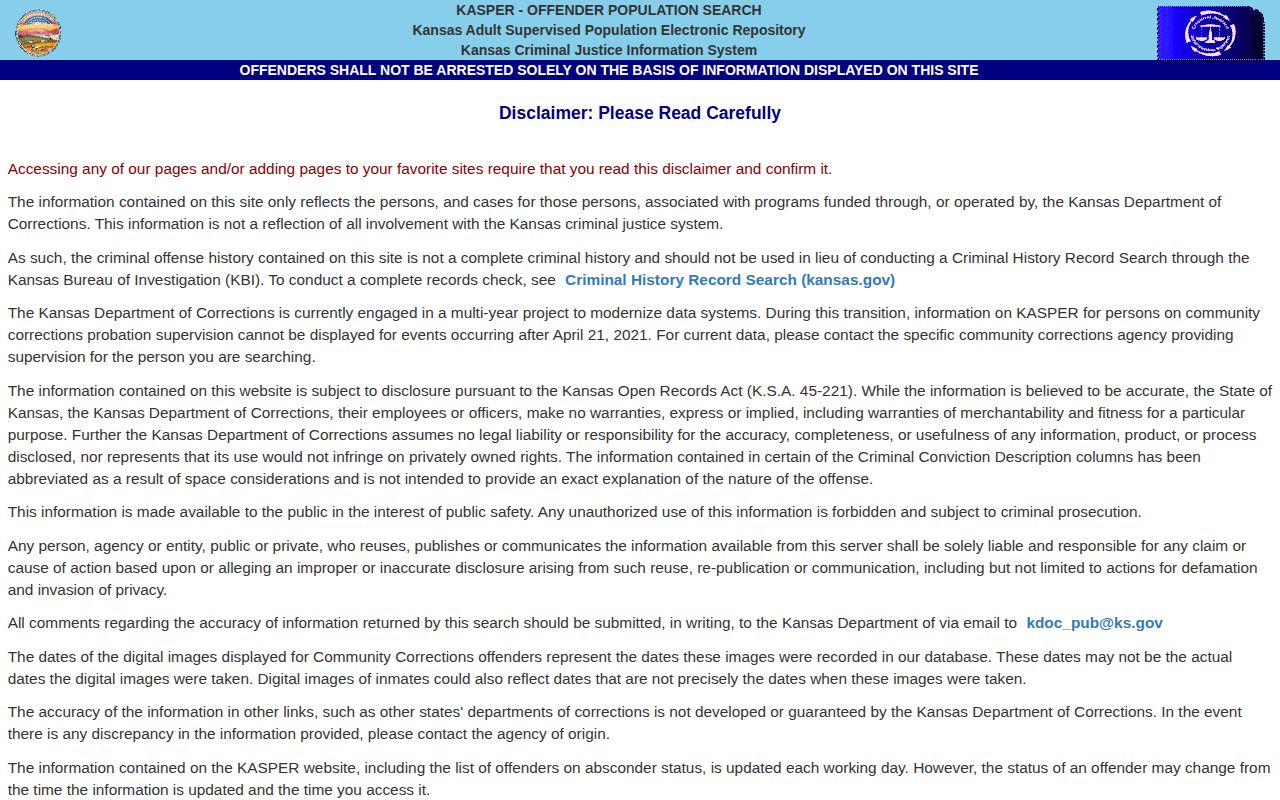
The portal is a state corrections source. It does not certify a purely local Dickinson County bond or time-served release.
KDOC Supervision After Release
A person outside prison can remain under KDOC authority. KASPER may show a parole office, supervision location, or type. The Salina Parole Office serves the local-facing state parole lane at 919 E. Prescott, Suite 300, Salina, KS 67401, 785-827-2584. Dickinson Community Corrections in Abilene is different. It handles qualifying court-ordered intensive-supervision cases, not state parole.
KASPER has known limits for modern community-corrections information, including post-April 2021 display gaps documented in the research. A stale or absent state community-corrections event therefore needs a local office check. For KDOC parole or postrelease, KASPER and the maintaining parole office remain the relevant sources. A discharged label means KDOC authority ended, but it does not erase the court case or any separate legal duty.
KDOC Absconder Status
KASPER offers separate parole and community-corrections absconder searches. An absconder is a person reported as knowingly avoiding supervision or making their whereabouts unknown to the supervising officer. It is not a discharge, successful completion, or proof of present incarceration.
Do not try to arrest or confront someone based on a listing. The official tool warns against arrest based only on its data. Use the official reporting route or law enforcement. A Dickinson filter describes the last reported supervision location, not a guaranteed current location or residence.
KDOC, Court, and County Proof
Each source proves a different part of the story. The Dickinson District Court file can show conviction, sentence, commitment, revocation, or satisfaction. The county jail record can show the actual local book-out and transfer destination if maintained. KDOC can show state intake, movement, prison release, supervision, and discharge. None should silently replace another.
| Question | Best source |
|---|---|
| When did Dickinson custody end? | County booking and release record |
| Why was the person committed? | Dickinson District Court record |
| Where did state custody move? | KDOC movement history |
| Did prison custody end? | KASPER supervision status and release fields |
| Did all KDOC authority end? | Discharged status or formal KDOC discharge record |
This jurisdiction-first method prevents the most serious error: calling a county-to-state transfer a release to the community.
KDOC Record Conflicts
A scheduled or anticipated date can differ from an actual movement or release. The Dickinson court may later correct jail credit. KDOC may adjust a computation after a sentence change, disciplinary credit action, revocation, or discovery of another controlling case. A public KASPER view may also reflect a later status than an older saved document. These are reasons to preserve the source date and field label, not reasons to choose whichever number seems most favorable.
When a person is near an anticipated release date, check KASPER again and use a custody-event notification only as a supplement. VINELink does not calculate a Kansas prison sentence. The Prisoner Review Board schedule also cannot replace KASPER. Its listed hearing month and earliest possible release month concern eligibility and process, not an actual release. No public named-person PRB decision database was found in the research, so a scheduled hearing must not be presented as a grant.
For formal proof, request the existing KDOC record designed for the fact. A public sentence computation answers how the state calculated key dates. A movement record answers where custody changed. A discharge certificate directly addresses the end of KDOC authority. If the question is the physical exit from the Dickinson jail before state intake, return to the county record instead. Clear source labels make apparent conflicts understandable and keep a projected event from being mistaken for a completed one.